


Technical Knowledge & Industry Blog
Stay informed with technical insights, testing standards, and environmental chamber innovations from SFTYE Equipment Co., Ltd.
What Is an Accelerated Cycle Corrosion Test Chamber?
Table of Contents
An Accelerated Cycle Corrosion Test Chamber is a controlled laboratory system designed to reproduce changing outdoor corrosion conditions. It exposes coated metals, fasteners, vehicle parts, or electronic enclosures to repeated phases of salt mist, humidity, drying, condensation, and temperature change. Unlike a continuous salt spray cabinet, it imitates a more realistic wet-and-dry environment.
The details matter. A typical cycle may begin with atomized saline solution, followed by a warm drying period. Moisture then condenses on the specimen surface. Small scratches can become visible corrosion sites. Edges may blister first. Crevices often reveal weaknesses that a single salt-fog test misses. Corrosion engineer R. Winston Revie defines the underlying problem clearly: “Corrosion is the deterioration of a material, usually a metal, due to a reaction with its environment.”
Testing must follow a documented method, such as ASTM G85, ISO 16701, or a customer-specific automotive procedure. However, no chamber can perfectly reproduce every road, marine, or industrial atmosphere. That limitation deserves attention. Results depend on solution chemistry, cycle duration, specimen orientation, temperature control, and inspection criteria. A reliable laboratory therefore records calibration data, photographs, mass changes, and coating failures throughout the exposure. Good practice also compares chamber results with field experience. The test is accelerated, not magical. It helps engineers rank materials and improve protection, but it should not replace sound design judgment. This article explains the chamber’s operating principles, key components, test cycles, maintenance requirements, and practical interpretation of results.
Definition and Purpose of an Accelerated Cycle Corrosion Test Chamber
What Is an Accelerated Cycle Corrosion Test Chamber?
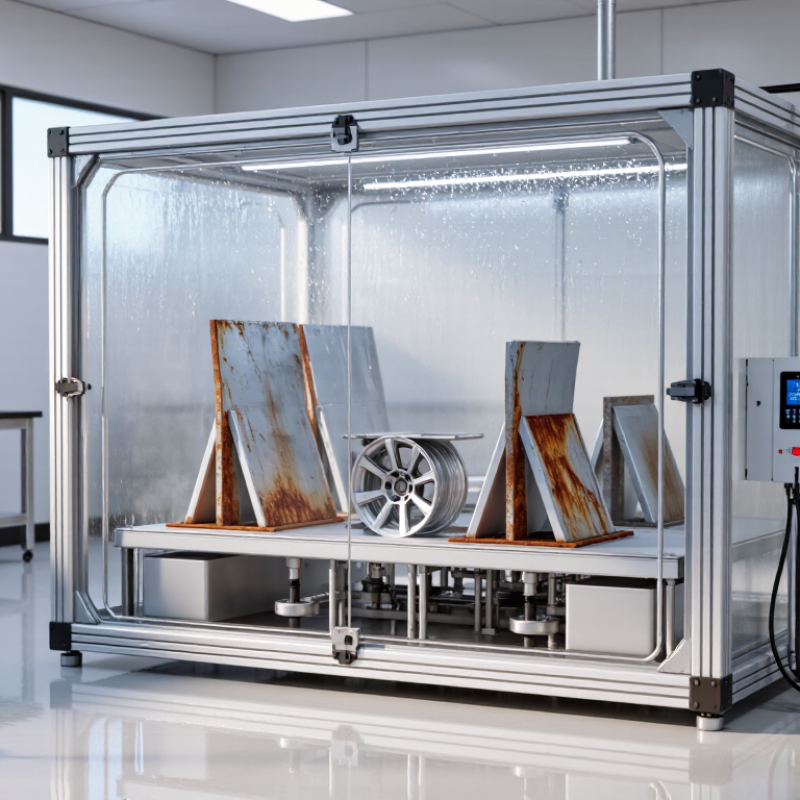
An accelerated cycle corrosion test chamber is a controlled enclosure for exposing materials to repeated corrosive environments. It commonly combines salt solution, high humidity, condensation, drying, and temperature changes. These cycles imitate harsh outdoor conditions more realistically than constant salt spray alone.
The chamber’s main purpose is to reveal corrosion weaknesses within a shortened testing period. Engineers use it to evaluate painted steel, coated parts, fasteners, and other exposed materials. A typical cycle may begin with salt mist, followed by humid condensation and a warm drying phase. Technicians then inspect blistering, red rust, creep from scratches, and coating adhesion. Small scribe marks matter. They can expose hidden differences between samples.
Reliable results depend on disciplined preparation. Operators should control solution concentration, chamber temperature, humidity, airflow, and specimen placement. Calibration records and consistent cleaning practices support credible comparisons. However, accelerated testing is not a perfect forecast of field life. Real environments include changing pollutants, sunlight, mechanical damage, and irregular wetting. The test may exaggerate some corrosion mechanisms or miss others. That limitation deserves attention.
From practical laboratory experience, poorly prepared edges can distort results. Fingerprints, uneven coating thickness, or blocked drainage may create misleading failure points. Repeating the test with defined procedures improves confidence. Engineers should interpret chamber data alongside material design, service conditions, and inspection evidence.
How the Chamber Reproduces Real-World Corrosion Conditions
An accelerated cycle corrosion test chamber is a controlled enclosure for studying how materials deteriorate. It exposes coated metals and assemblies to repeated moisture, salts, heat, and drying. These cycles compress months or years of environmental stress into a practical laboratory schedule. The method is not simple salt spraying. It imitates changing weather.
A typical program begins with warm, humid air that allows moisture to settle on the test surface. The chamber then introduces fine saline mist, simulating airborne chlorides near roads or coastlines. A drying phase follows, leaving salt deposits behind. Later, condensation or temperature changes restart the corrosion process. Some procedures add ultraviolet exposure when outdoor aging is relevant. Sensors record temperature, humidity, spray duration, and chamber conditions. Technicians inspect panels for blistering, red rust, edge creep, and coating loss.
Reliable results depend on calibrated sensors, verified solution concentration, and clean spray nozzles. Operators should also record interruptions and unexpected surface changes. Recognized corrosion standards provide useful frameworks, but the test profile must match the service environment. A marine fastener may need chloride-rich wet-dry cycles, while an underbody part may require mud contamination and thermal movement. No chamber perfectly copies outdoor exposure. That limitation matters. Poorly chosen cycles can rank materials incorrectly, even when measurements look precise. Engineers should compare chamber findings with field inspections and revise the profile when evidence disagrees.
What Is an Accelerated Cycle Corrosion Test Chamber?
How the chamber reproduces real-world corrosion conditions through repeated salt exposure, humidity, drying, and temperature changes.
This representative 24-hour cycle combines a 2-hour salt-fog phase using 5 wt% sodium chloride at 35°C with humidity and drying stages. The salt-fog settings reflect commonly specified neutral salt-spray conditions, while the remaining stages illustrate how cyclic testing creates repeated wet–dry and thermal transitions that are more representative of outdoor corrosion than continuous salt fog alone. Exact programs vary by test method and product requirements.
Main Components and Operating Cycle
What Is an Accelerated Cycle Corrosion Test Chamber?
Main Components and Operating Cycle
An accelerated cycle corrosion test chamber recreates harsh outdoor conditions inside a controlled enclosure. It combines salt exposure, humidity, temperature changes, and drying periods. The goal is to reveal coating defects, joint weaknesses, and early corrosion faster than natural exposure.
The chamber usually contains a corrosion-resistant test cabinet, solution reservoir, atomizing nozzle, air supply, heater, humidifier, and drainage system. Racks hold specimens at a defined angle. Sensors monitor temperature and relative humidity. A programmable controller changes each stage and records the actual conditions. Small details matter. Poor drainage can dilute test results.
A typical operating cycle begins with preconditioning at controlled humidity. The chamber then produces a fine salt mist over the specimens. After exposure, the environment shifts to high humidity, allowing moisture to remain on the surfaces. A warmer, drier stage follows. This drying period can concentrate salts inside scratches and coating pores. The cycle repeats for a specified duration.
Operators should inspect nozzles, solution concentration, seals, and calibration before testing. A blocked nozzle may create uneven deposits. That result can look convincing but remain unreliable. The method is useful, yet not perfect. It accelerates selected corrosion mechanisms, not every outdoor condition. Results should be compared with coating requirements, failure criteria, and supporting material data.
Test Methods, Sample Preparation, and Evaluation
What Is an Accelerated Cycle Corrosion Test Chamber?
Test Methods, Sample Preparation, and Evaluation
An accelerated cycle corrosion test chamber recreates changing outdoor conditions in a controlled space. It alternates salt exposure, humidity, drying, and temperature changes. This cycle often reveals coating defects faster than continuous salt spray. The selected method should match the product’s expected environment. Coastal, industrial, and road-salt conditions require different exposure profiles. Follow the relevant testing standard carefully, but do not treat it as a universal prediction tool.
Sample preparation strongly affects the result. Clean each panel with a suitable solvent, then handle it with gloves. Record the substrate, coating thickness, curing condition, and surface finish. Mask mounting holes and edges when required. Some evaluations use a controlled scribe through the coating. Place samples at the specified angle, with enough spacing for airflow. Include reference panels when possible. Small preparation errors can create large corrosion differences.
Inspect samples at planned intervals, not only after failure. Photograph the same areas under consistent lighting. Record rust, blistering, cracking, peeling, and corrosion spread from the scribe. Measure creepage with a ruler or image analysis tool. Weight loss and adhesion testing can add useful evidence. Personal judgement still affects visual ratings. That weakness deserves attention. Repeat testing, blind reviews, and calibrated scoring reduce inconsistency. Chamber temperature, spray concentration, humidity, and cycle timing must remain documented throughout the exposure.
Industrial Applications and Key Benefits
An accelerated cycle corrosion test chamber reproduces harsh outdoor exposure inside a controlled enclosure. It alternates salt spray, humidity, drying, and temperature changes. Coated panels, fasteners, vehicle parts, and electrical housings can be tested within weeks. Real weather may require months or years.
Industrial applications are broad. Automotive engineers use cyclic exposure to compare paint systems, underbody protection, and galvanized components. Aerospace teams examine fasteners and treated alloys under repeated moisture and salt conditions. Marine and infrastructure manufacturers test brackets, enclosures, pipelines, and bridge hardware. The practical benefit is clear: controlled cycles reveal blistering, creep, edge corrosion, and coating breakdown before field deployment.
The 2016 NACE IMPACT study estimated global corrosion costs at US$2.5 trillion, or 3.4% of global GDP. A U.S. Federal Highway Administration report estimated annual corrosion costs near US$276 billion. These figures explain why earlier material screening matters. A chamber can reduce comparison time, improve repeatability, and support evidence-based maintenance planning. However, it is not a crystal ball. ISO 9227 and cyclic corrosion methods do not perfectly reproduce every location. Test duration, panel preparation, cycle selection, and inspection judgment can change results. That weakness deserves attention. Field validation remains necessary, especially for complex assemblies and unusual climates.
FAQS
It is a controlled enclosure for repeating salt mist, humidity, drying, and temperature changes. These cycles expose corrosion weaknesses faster than outdoor weather.
Engineers test painted steel, coated panels, fasteners, vehicle parts, electrical housings, and treated alloys. Small scratches often reveal hidden coating weaknesses.
The cycle may begin with controlled humidity and fine salt mist. High humidity follows, then warm drying concentrates salts inside scratches and pores.
Common components include a corrosion-resistant cabinet, solution reservoir, nozzle, heater, humidifier, sensors, racks, and drainage system. Each part affects consistency.
Inspectors look for blistering, red rust, edge corrosion, coating creep, and poor adhesion. A tiny scribe mark can expose major differences.
Fingerprints, uneven coatings, damaged edges, or blocked drainage can create misleading failure points. The test may look precise, yet preparation can quietly distort it.
They should check nozzle condition, solution concentration, seals, temperature, humidity, airflow, and calibration records. A blocked nozzle can produce uneven deposits.
No. The test accelerates selected corrosion mechanisms, not every real-world condition. Sunlight, pollutants, mechanical damage, and irregular wetting may change field performance.
They should repeat tests using defined procedures and consistent specimen placement. Results should also be compared with field inspections and actual service conditions.
It shortens comparison time and supports earlier material decisions. Weeks of controlled exposure may reveal defects before deployment, but field validation remains necessary.
Conclusion
An Accelerated Cycle Corrosion Test Chamber is a laboratory system designed to evaluate how materials, coatings, components, and finished products resist corrosion under controlled and intensified environmental conditions. By combining programmed stages such as salt spray, humidity, drying, condensation, and temperature changes, it reproduces the repeated moisture and chemical exposure that products may experience in real-world service. This approach helps shorten testing time while providing meaningful information about long-term durability.
A typical chamber includes a corrosion-resistant enclosure, solution delivery system, temperature and humidity controls, circulation equipment, sensors, and an automated controller. During testing, prepared samples are cleaned, identified, positioned, and exposed to a defined operating cycle. Afterward, they are evaluated for rust, blistering, peeling, cracking, staining, and other surface changes according to established procedures. These tests support quality control, product development, material selection, and performance verification in industries such as transportation, construction, manufacturing, and infrastructure. Key benefits include repeatable conditions, efficient comparison of protective systems, early identification of weaknesses, and improved confidence in product service life.

Blog Tags: